How to Launch a European Protein Snack Brand in a New Market
Kort sammanfattat
To launch a protein snack brand in a new European market, work backwards from the buyer: validate a real shelf gap, choose your route to market (own brand, private label or distributor), lock down EU labelling and claims compliance, then price from the shelf edge so every party keeps margin.
TL;DR
- Launch a protein snack brand by validating the shelf gap, choosing the right route to market, nailing EU compliance, and pricing from the shelf edge down.
To launch a protein snack brand in a new European market, sequence the work from the buyer backwards, not from the factory forwards. The reliable order is: confirm there is a genuine gap on the shelf, choose the right route to market (own brand, private label, or distributor partnership), lock down EU labelling and claims compliance, then build a price architecture that leaves workable margin for every party in the chain. Knowing how to launch protein snack brand products in an unfamiliar market is far less about the recipe and far more about the route to the buyer; rushing to manufacture before you have a proven path to a listing is the most common and most expensive mistake founders make.
Before you launch protein snack brand lines, start with the shelf
Category managers do not buy products; they buy solutions to a range gap. Before you commit to a single production run, walk the target retailer's fixture (physically or through their planogram data) and answer three questions honestly. Is there an unmet need at a specific price point? Which incumbent would this delist, and can you justify the swap on rate of sale, not just novelty? And does your format bring an incremental shopper into the category rather than cannibalising an existing line?
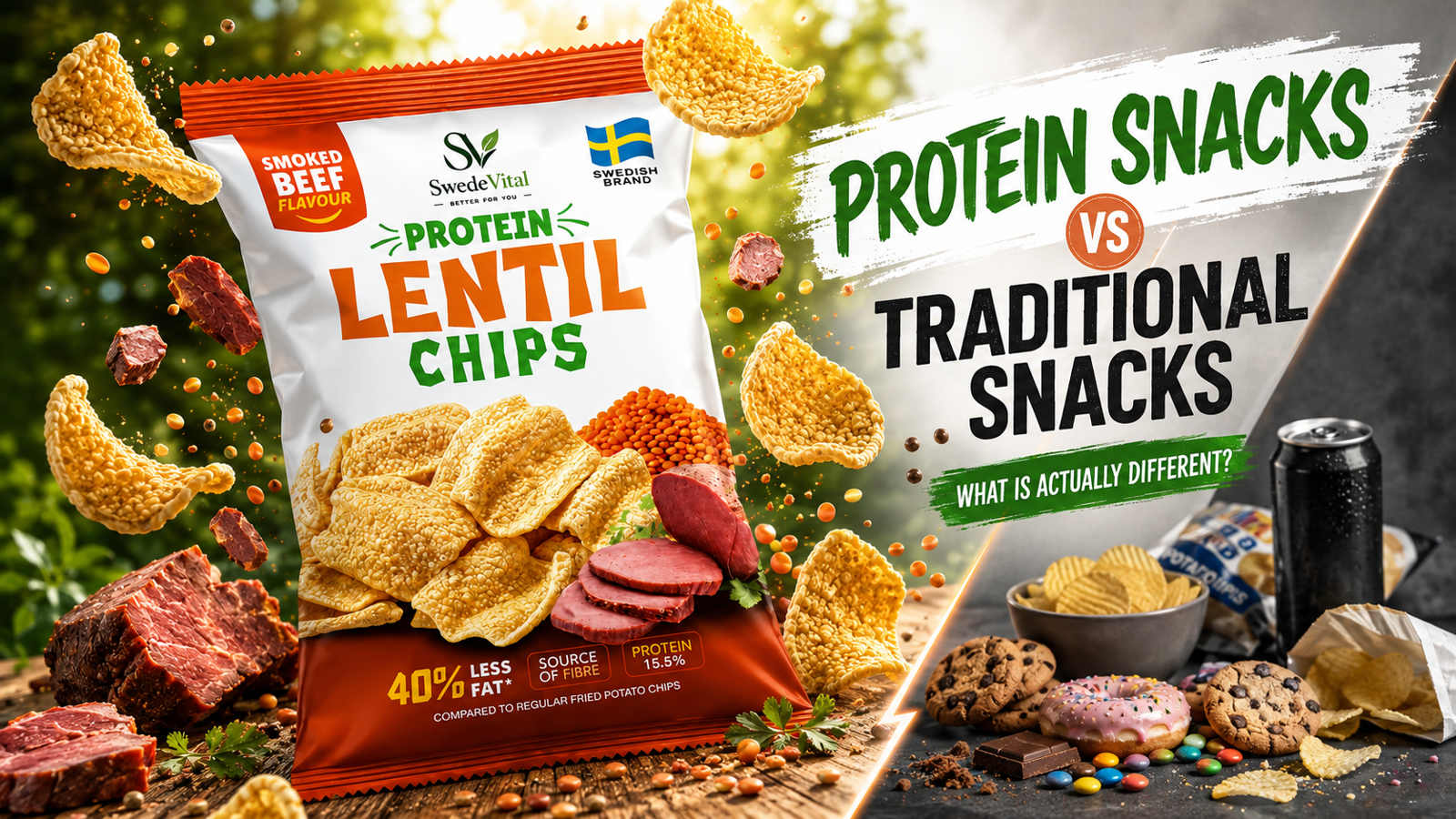
This matters because European retail protein has matured well beyond powders and shakes. A buyer will already stock bars, and increasingly savoury formats such as protein chips and bites. If your pitch is "another protein bar," you are competing on price against entrenched suppliers. If your pitch is "a savoury, lower-sugar alternative that the bar fixture doesn't serve," you are creating incremental sales — the single argument that opens a listing.
Snack formats versus the powder aisle
It is worth being clear about where you are playing. Search demand for protein powder is enormous, but it is a different shopper mission: planned, bulk, goal-driven, and largely online or in sports-nutrition retail. Protein snacks win on impulse, convenience and on-the-go moments in grocery, convenience and travel retail. Do not position a snack against powder economics; position it against the crisps, cereal bars and confectionery it will physically sit beside.
Choose your route to market before you tool up
The route you pick decides your capital needs, speed and control. There are three viable paths, and mixing them deliberately is often smartest.
- Own brand, own manufacturing or co-pack: maximum control and margin, maximum risk and cash. You own the shelf story, the IP and the reorder rhythm, but you carry inventory, listing fees and marketing.
- Private label for a retailer or wholesaler: you produce to a buyer's brand. Volumes can be large and demand is semi-guaranteed by the retailer, but margins are thinner and you are exposed to a single customer's fortunes. This is often the fastest way to fund a factory line while you build your own label alongside.
- Distributor or importer partnership: a local partner already holds the retailer relationships, warehousing and compliance know-how in the target country. You trade margin for reach and speed. For a first market entry, a strong distributor frequently beats going direct.
A practical hybrid many manufacturers use: enter a new market through a distributor to prove sell-through, run private-label volume to keep the line efficient, and reserve a premium own-brand tier for the customers who ask for something the private-label range can't deliver.
Match the route to your honest constraints. If cash is tight and speed matters, a distributor gets you on shelf without funding a marketing team abroad. If you already own capacity and want to keep it running while you build equity, private-label contracts smooth the utilisation curve. If your differentiator is brand and formulation — say a savoury protein chip or a functional-wellness format that no one else offers — protect it under your own label and accept the slower, more capital-hungry climb. The wrong move is defaulting to own-brand-everywhere because it feels ambitious; ambition that outruns cash is how promising brands stall in year one.
Get EU compliance right, because a buyer will check
Nothing kills a promising listing faster than a label that cannot legally make its central claim. In the EU, nutrition and health claims are governed by Regulation (EC) No 1924/2006. Two points every founder must internalise:
- Protein claims are threshold-based. "Source of protein" and "high in protein" are defined nutrition claims with fixed criteria under EU law — you cannot use them unless your product meets the stated proportion of energy from protein. Design the recipe to clear the threshold you want to claim, and keep the lab analysis on file.
- Function and health claims are tightly restricted. Only authorised health claims may appear, and for many botanicals — including several functional mushrooms — claims are unauthorised or "on hold" at EU level. A buyer's technical team will reject packaging that implies benefits the law does not permit.
Beyond claims, confirm your allergen labelling, mandatory nutrition declaration per 100 g, ingredient ordering, novel-food status of any newer ingredient, and country-specific language requirements. If you also sell a functional-wellness range — for example mushroom capsules, sprays or gummies, or creatine and magnesium formats — treat those under the correct food-supplement rules, which differ from ambient snacks. When in doubt, describe benefits in evidence-led, non-committal language: research suggests a nutrient may support a function, never a guaranteed outcome.
The fastest way to lose a category manager's trust is to over-claim. The fastest way to earn it is a clean spec sheet, a compliant label, and honest data.
Build a price architecture that survives the whole chain
New founders price from cost up and hope. Buyers price from the shelf edge down. Work backwards from the retail price the shopper will accept for your format, then subtract each party's margin: retailer, distributor, and your own. What remains is your target ex-works cost — and if the recipe cannot be made profitably at that cost, you change the recipe, the pack size or the channel, not the shelf price.
Three levers protect margin without cheapening the product: pack architecture (a smaller "trial" count price alongside a value multipack), ingredient specification (protein source and inclusion rate are your biggest cost drivers), and promotional planning agreed up front so deep discounts don't erase your margin in month two. Never quote a buyer a price you cannot hold through a full year of promotions.
Plan supply before you plan marketing
A launch fails just as easily from success as from weakness: a product that sells out and cannot be reordered burns the retailer relationship you worked months to win. Before you spend on marketing, pressure-test the boring operational spine. Do your lead times allow a reorder before the shelf goes empty? Is your shelf life long enough for the retailer's distribution and replenishment cycle? Can you hold your minimum order quantities and case configurations to what a European retailer's supply chain actually expects, rather than what suits your factory? And if demand spikes twice as fast as forecast, what is your contingency — a second co-packer, a safety-stock buffer, or a capped rollout? Buyers reward suppliers who answer these questions before being asked. On-time, in-full delivery is not a nice-to-have; it is the reputation you trade on for every future listing.
How to launch protein snack brand products a buyer will list
The listing decision is made in a short, evidence-driven conversation. Bring a one-page sell sheet with the shopper problem, the incremental sales argument, the price and margin for the retailer, and proof of supply reliability. Buyers derisk suppliers as much as they buy products, so lead with your ability to deliver on time, in full, with compliant paperwork.
What a category manager actually wants to see
- A clear reason the category grows because of you, not just shuffles.
- Proof you can supply consistently — capacity, lead times, shelf life, and a credible plan if demand spikes.
- Full technical and compliance documentation ready before the first order, not promised after.
- A launch support plan: sampling, secondary siting, or trade spend that helps the product achieve rate of sale.
- Sensible minimum order quantities and case configurations that match how the retailer's supply chain actually works.
Choose the first market deliberately
"Europe" is not a market; it is dozens of them with different diets, price sensitivities and retail structures. Pick a beachhead where three things line up: existing demand signals for better-for-you snacking, a retail or distribution partner willing to trial, and a regulatory and language footprint you can service without heavy overhead. Prove the model in one country and one channel, gather real sell-through and repeat-purchase data, then use that evidence — not ambition — to justify expansion. A tight, proven launch in a single market is far more fundable than a thin presence spread across five.
Pre-launch checklist
- Validated shelf gap and incremental-sales story for the target fixture.
- Chosen route to market (own brand, private label, distributor) with the capital plan it implies.
- Recipe engineered to hit the exact protein claim threshold you intend to use.
- Fully compliant label: claims, allergens, nutrition per 100 g, language, novel-food and supplement status where relevant.
- Price architecture reverse-engineered from the shelf edge, with promo plan agreed.
- Supply proof: capacity, lead times, shelf life, MOQs and a contingency for demand spikes.
- Buyer sell sheet and technical pack ready before the first meeting.
- A single beachhead market and channel chosen, with a measurement plan for sell-through and repeat purchase.
Handle those eight in order and you don't just launch a protein snack brand — you launch one a buyer can say yes to, and a supply chain can actually sustain.
Vanliga frågor
How do you launch a protein snack brand in a new market?
Work backwards from the buyer. Validate a real shelf gap, choose your route to market (own brand, private label, or distributor), get EU labelling and claims compliance right, and reverse-engineer a price that leaves margin for the whole chain. Prove sell-through in one market before expanding.
Is it better to sell protein snacks or protein powder?
They serve different shopper missions. Protein powder is a planned, bulk, goal-driven purchase concentrated in sports-nutrition and online channels. Protein snacks win on impulse and convenience in grocery, convenience and travel retail. If your product is a snack, position and price it against snacks, not against the powder aisle's economics.
Should a new brand use private label or launch its own brand?
Private label offers faster, semi-guaranteed volume through a retailer's brand but thinner margins and single-customer risk. Own brand gives control, IP and margin but demands capital and marketing. Many manufacturers do both: private-label volume keeps the line efficient while a premium own-brand tier builds equity.
What EU rules apply to protein and health claims on snacks?
Nutrition and health claims fall under EU Regulation (EC) No 1924/2006. Protein claims like "source of" or "high in" protein are threshold-based and only usable if the product meets the defined proportion of energy from protein. Many botanical and functional claims are unauthorised, so keep language evidence-led and non-committal.
How should you price a protein snack for retail?
Price from the shelf edge down, not from cost up. Start with the retail price the shopper will accept, subtract retailer, distributor and your own margins, and treat what remains as your target ex-works cost. If the recipe can't be made profitably at that cost, change the pack, spec or channel.
Which European market should you launch in first?
Pick one beachhead where demand signals for better-for-you snacking, a willing retail or distribution partner, and a manageable regulatory and language footprint all align. Prove the model with real sell-through and repeat-purchase data in a single country and channel before spreading across multiple markets.