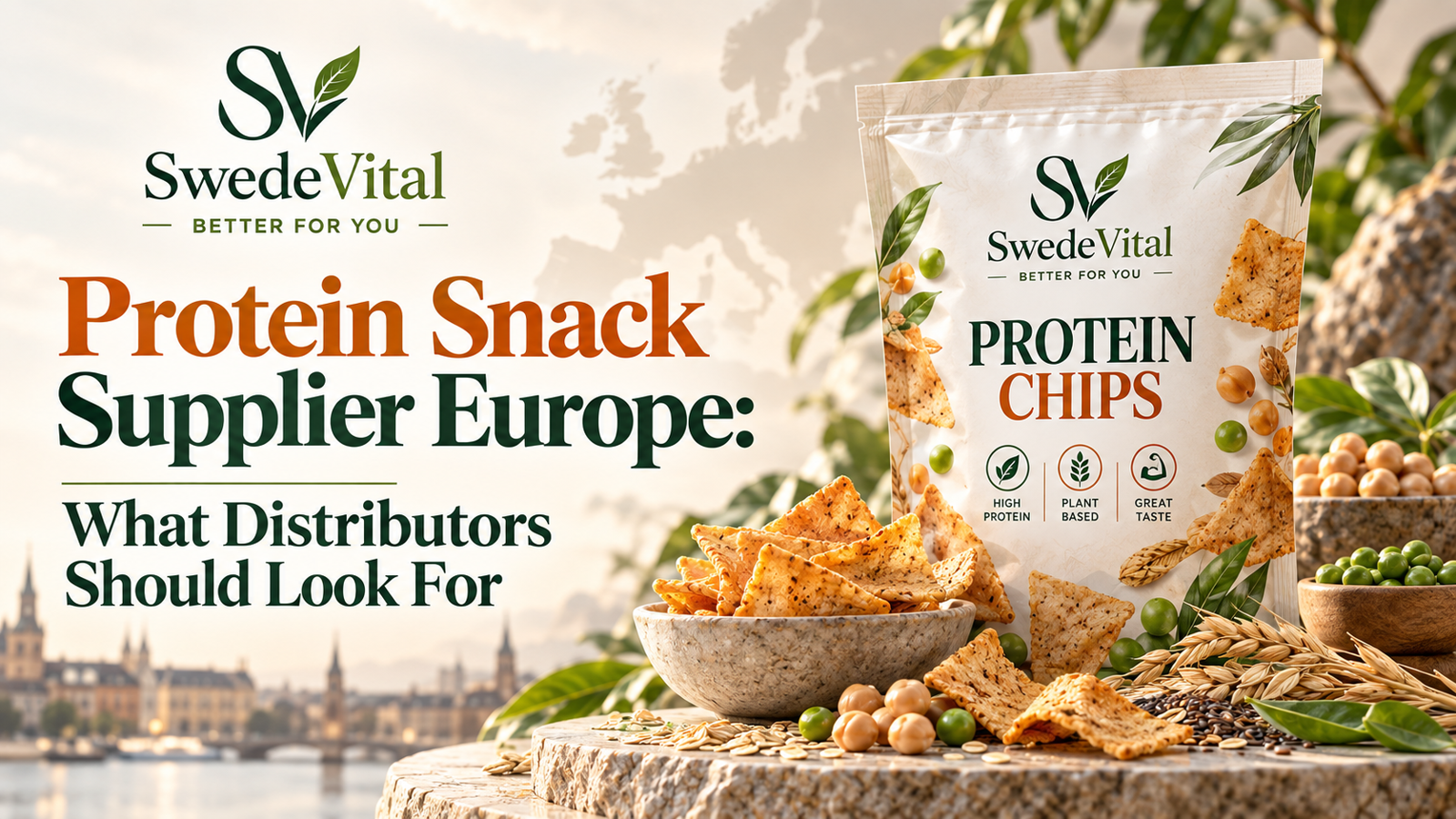
Protein Snack Supplier Europe: What Distributors Should Look For
Kort sammanfattat
When selecting a protein snack supplier in Europe, distributors should assess regulatory competence, formulation quality, format range, supply reliability, and commercial flexibility to ensure compliant, high‑quality products that meet market demands.
TL;DR
- Distributors must evaluate protein snack suppliers on compliance, quality, range, reliability, and flexibility to secure compliant, high‑quality products.
Choosing a protein snack supplier in Europe comes down to five things: regulatory competence, formulation quality, format range, supply reliability, and commercial flexibility. The strongest partner for a distributor is rarely the cheapest per-unit manufacturer — it is the one that can keep shelves filled with compliant, on-trend products that shoppers actually reorder. This guide sets out what buyers, wholesalers and private-label partners should scrutinise when they evaluate a protein snack supplier Europe distributors can trust, and the trade-offs that separate a reliable long-term source from a costly mistake.
Why your protein snack supplier Europe decision is strategic, not a price line
Protein snacks sit in one of the fastest-moving corners of the better-for-you category. Category managers are competing for limited shelf and listing space, and a poor sourcing decision shows up quickly as out-of-stocks, recalls, or slow sell-through that a store simply delists. The supplier you pick effectively becomes part of your own reliability promise to your customers.
That is why experienced distributors treat the choice as a partnership question rather than a procurement transaction. A per-unit price that looks attractive on a spreadsheet means little if lead times slip during peak season, if labels are not compliant in the destination market, or if the manufacturer cannot scale with you once a listing performs. Evaluate the supplier the way your own customers evaluate you: on consistency, transparency, and the ability to solve problems before they reach the shelf.
Core criteria for evaluating a protein snack supplier Europe
Before you request samples or a price list, build a scoring framework so every candidate is judged on the same terms. When you compare any protein snack supplier Europe-wide, these criteria matter most:
- Regulatory and labelling competence — can they produce labels and claims that are compliant in each market you sell into, not just their home country?
- Formulation and ingredient quality — protein source, clean-label credentials, allergen control, and taste and texture that survive shelf life.
- Certifications and food-safety systems — recognised standards such as BRCGS, IFS or ISO 22000, plus HACCP and any organic or vegan certifications relevant to your buyers.
- Manufacturing control — do they own production or subcontract it? In-house manufacturing usually means tighter quality control and faster iteration.
- Capacity and supply resilience — realistic lead times, backup ingredient sourcing, and headroom to grow with a successful listing.
- Commercial flexibility — minimum order quantities, private-label options, and willingness to co-develop.
Score each candidate honestly across these areas rather than letting a single strong feature — usually price — dominate the decision.
Ask for documentation, not adjectives
Any credible manufacturer can hand over specification sheets, certificates of analysis, allergen matrices, and audit certificates on request. If a supplier is slow or vague when you ask for paperwork during courtship, assume it will be worse once you are a live account. Documentation is the clearest early signal of operational maturity.
Regulatory and labelling realities across the EU and EEA
Selling into the European market means operating under EU food law, including Regulation (EU) No 1169/2011 on food information to consumers and Regulation (EC) No 1924/2006 on nutrition and health claims. In practice, a product can only carry a claim such as "high in protein" or "source of protein" when it meets the defined thresholds set out in those rules. A supplier who understands this will build compliant claims into the artwork; one who does not creates enforcement risk that lands on you.
Labelling is not purely a translation exercise. Ingredient declarations, allergen emphasis, nutrition panels, and country-specific requirements all need to be right for each destination. If you distribute across several markets, confirm early who is responsible for label accuracy and who carries liability if something is wrong. The cleanest arrangement is a supplier that treats compliance as their job, with your legal review as a second line of defence rather than the only line.
Product range and formats that actually move
Buyers increasingly want breadth from a single source, because consolidating suppliers reduces administrative overhead and simplifies logistics. In the protein snack aisle, the formats doing the heavy lifting include savoury options such as protein lentil chips, portable protein bites and natural bites, and the familiar protein bar. Savoury and whole-food-style snacks in particular have expanded the category beyond the traditional sweet bar, opening incremental shelf space rather than cannibalising it.
It helps to understand where snacks sit relative to the broader protein market. Protein powder remains the highest-volume protein product by search demand and is the anchor of the sports-nutrition set, but it serves a different shopper mission: deliberate, planned supplementation at home. Protein snacks capture the impulse and on-the-go occasions that powders cannot — grab-and-go, lunchbox, travel and desk snacking. A distributor building a protein category strategy should stock both missions rather than treat snacks as a lesser version of powder. The two formats grow the basket together.
Range breadth also future-proofs a listing. A supplier whose catalogue spans several snack formats — and ideally adjacent functional lines such as mushroom-based capsules, sprays and gummies, creatine or magnesium sleep gummies — lets you expand a relationship without re-running the whole vetting process. SwedeVital, for example, manufactures across both plant-based protein snacks and a functional-wellness range, which is the kind of one-source breadth that reduces onboarding friction for a distributor.
Private label versus branded distribution
One of the earliest strategic forks is whether you want branded product, private label, or both. Each has a distinct risk-and-margin profile.
- Branded distribution gives you proven products with existing consumer recognition and marketing support, at the cost of thinner margins and less control over the range.
- Private label typically improves margin and gives you a differentiated own-brand story, but it shifts more responsibility onto you for demand forecasting, artwork, and shelf marketing — and usually requires higher minimums.
If private label is on the table, probe the supplier’s development capability specifically. Can they adjust recipes, flavours, formats and pack sizes, and what does the development timeline and cost look like? A manufacturer that owns its production lines can usually iterate faster and support smaller trial runs than one that outsources. Clarify who owns the formulation and artwork, because that determines how easily you could move production later if you ever needed to.
Logistics, MOQs and lead times
Commercial terms decide whether a good product is actually workable for your business. Minimum order quantities vary widely and interact with shelf life: a low per-unit price is no bargain if the MOQ forces you to hold more stock than you can sell before best-before dates approach. Model the full landed cost — unit price, freight, duties where relevant, and the working capital tied up in inventory — not just the quoted case price.
Lead times deserve the same scrutiny. Ask for typical production and replenishment times, how the supplier handles demand spikes, and what happens if a key ingredient is delayed. A European manufacturing base can be a genuine advantage here: shorter transit, simpler customs, and easier communication in compatible time zones all reduce the risk of empty shelves. Reliability during a promotion or seasonal peak is where suppliers are truly tested, so ask how they have handled surges before.
A practical supplier evaluation checklist
Use this checklist to structure sample requests, factory questions and reference checks. Treat any refusal to answer as information in itself:
- Which food-safety certifications do you hold (for example BRCGS, IFS, ISO 22000), and can I see current certificates?
- Do you manufacture in-house or subcontract, and where are your production sites located?
- Can you provide compliant labelling and claims for each market I sell into under EU food-information and health-claims rules?
- What are your minimum order quantities, lead times, and typical shelf life at delivery?
- Do you offer private label, and what does co-development cost and timeline look like?
- How do you manage allergen control, ingredient traceability, and backup sourcing?
- What is your process if a quality issue or recall arises, and who carries liability?
- Can you share references from existing distributor or retail customers?
Score candidates, request samples from your shortlist, and run a small trial listing before committing to volume. The goal is a supplier who behaves like a partner in your success, not just a factory that ships boxes.
Frequently asked questions
What should distributors look for in a protein snack supplier in Europe?
Prioritise regulatory and labelling competence, food-safety certifications, in-house manufacturing control, a range of formats, realistic MOQs and lead times, and private-label flexibility. The cheapest quote rarely wins once you account for compliance, reliability and the working capital tied up in inventory.
How is a protein snack different from protein powder?
Protein powder is the highest-volume protein format and serves planned, at-home supplementation. Protein snacks — bars, bites and savoury options like lentil chips — serve on-the-go and impulse occasions. They grow the basket together, so most distributors stock both rather than choosing one.
What certifications matter when sourcing protein snacks?
Look for recognised food-safety schemes such as BRCGS, IFS or ISO 22000, underpinned by HACCP, plus any organic, vegan or allergen certifications your buyers require. Always ask for current, verifiable certificates rather than relying on general claims of compliance.
Should I choose branded or private-label protein snacks?
Branded product offers recognition and marketing support at lower margin; private label improves margin and differentiation but shifts more forecasting and marketing responsibility onto you and usually needs higher minimums. Many distributors run both, using private label to build an own-brand story alongside proven brands.
What questions reveal whether a supplier is reliable?
Ask for certificates, specification sheets and references, and probe how they handled past demand spikes, ingredient delays and any quality issues. Suppliers that answer documentation requests quickly and specifically during courtship are usually the ones that stay dependable once you are a live account.
Related reading
- protein snack trends
- becoming a protein snack distributor
- protein snacks vs traditional snacks
- scaling a protein snack brand
Sources
- Regulation (EC) No 1924/2006 of the european parliament and of the council of 20 December 2006 on nutrition and health c
- Rest-Of-Europe Extruded Protein Crispies and Inclusions Market Size, Share,Trends, Growth Analysis Report, 2031
- Regulation (EU) No 1169/2011 of the European Parliament and of the Council of 25 October 2011 on the provision of food i
Vanliga frågor
What are the top five criteria for choosing a protein snack supplier in Europe?
The five key criteria are regulatory competence, formulation quality, format range, supply reliability, and commercial flexibility.
Why is regulatory competence important for a protein snack supplier?
It ensures labels and claims comply with EU food law, reducing enforcement risk and protecting the distributor’s reputation.
How does format range affect a distributor’s product strategy?
A broad format range allows distributors to offer diverse snack options, capture impulse buying, and future‑proof listings by expanding into adjacent functional lines.
What role does supply reliability play in the distributor’s success?
Reliable lead times, backup ingredient sourcing, and capacity to scale prevent out‑of‑stocks, recalls, and slow sell‑through that can lead to delisting.
What should distributors look for in commercial flexibility?
They should seek suppliers with low minimum order quantities, private‑label options, and willingness to co‑develop products to adapt to market trends.