Reishi Gummies: What Are They and How Do They Fit Into a Wellness Routine?
Kort sammanfattat
Reishi gummies are chewable food supplements delivering an extract of the reishi mushroom (Ganoderma lucidum) in a sweetened form. Part of the popular mushroom gummies category, reishi is traditionally used as a calming adaptogen and has been studied for immune and sleep support, though no EU health claim is authorised. Consistency matters more than any single dose.
TL;DR
- Reishi gummies are a palatable, evidence-led way to add a traditionally calming functional mushroom to a daily wellness routine, provided you check the label for a real extract, quantified beta-glucans and independent testing.
Reishi gummies are chewable food supplements that deliver an extract of the reishi mushroom (Ganoderma lucidum) in a sweetened, pectin- or gelatine-based form. Traditionally used in East Asian herbal practice and now one of the most searched entries in the wider mushroom gummies category, they offer a low-friction way to fold a functional mushroom into a daily routine — provided you know how to read the label. This primer explains what reishi is, what the research does and does not support, and how Reishi gummies compare with capsules, sprays and powders, so buyers and consumers can make an informed choice.
What are Reishi gummies?
Reishi is a woody, bitter mushroom that has been used in traditional Chinese and Japanese herbal systems for centuries, where it is sometimes called lingzhi or the “mushroom of immortality.” It sits among the adaptogens — botanicals traditionally used to help the body cope with everyday stress. Because the raw mushroom is too tough and bitter to eat, it is almost always consumed as an extract rather than as food.
A Reishi gummy encapsulates that extract in a soft, flavoured chew. The appeal is simple: gummies taste pleasant, need no water, and turn a supplement into something closer to a small daily ritual. That palatability is the main reason mushroom gummies have grown from a niche into a mainstream wellness format. The format lowers the barrier to consistency, which — for a slow-acting botanical — matters more than any single serving.
Fruiting body, mycelium or “mushroom powder”?
Not all reishi is equal. Products may use the fruiting body (the mushroom itself), mycelium (the root-like network, often grown on grain), or a concentrated extract of either. Extracts made from the fruiting body are generally the most sought-after because they tend to concentrate the compounds of interest, while grain-grown mycelium can carry residual starch that dilutes what you are actually paying for. The distinction is worth understanding before comparing two products on price alone.
What the research actually says about reishi
Honesty matters here, especially in Europe. Reishi has been studied for a range of effects and carries a long record of traditional use, but that is not the same thing as proven medical benefit. Under EU food-supplement rules no specific health claim for reishi has been authorised, so responsible sellers describe it carefully. What can be said fairly is narrow but genuine:
- Reishi is traditionally used as a calming tonic and adaptogen in East Asian herbal practice.
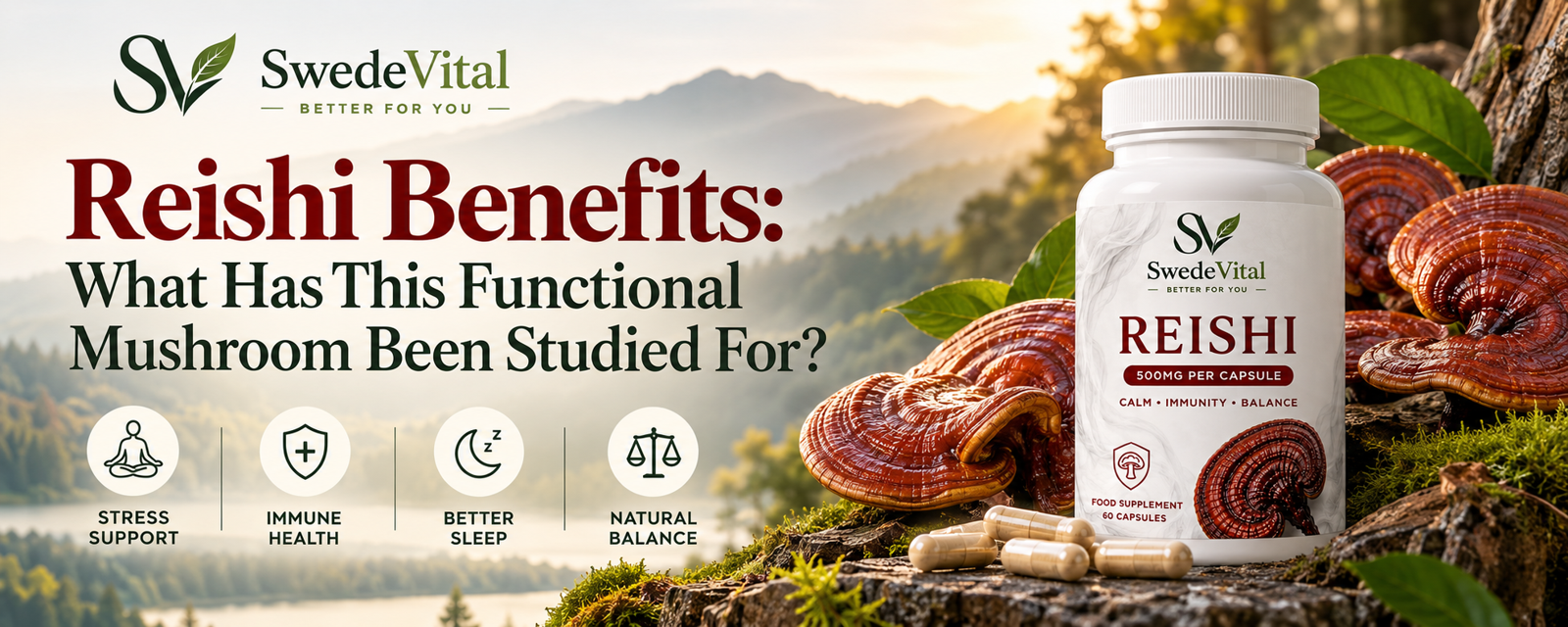
- It has been studied for its potential role in immune modulation, sleep quality, stress resilience and general vitality.
- Its compounds of interest include beta-glucans (a type of polysaccharide) and triterpenes, which is precisely why the extraction method matters.
- Research suggests avenues worth further study rather than settled conclusions; human evidence is still developing.
The trustworthy way to talk about reishi is in the language of tradition and ongoing research — “traditionally used for,” “has been studied for,” “may support” — never in the language of cures or guaranteed outcomes.
How Reishi gummies fit into a wellness routine
Reishi is most often associated with the wind-down end of the day. Because it is traditionally used as a calming adaptogen, many people take their Reishi gummies in the evening as part of a pre-sleep ritual, though nothing requires it. The more important principles are consistency and realistic expectations.
- Be consistent. Adaptogens are traditionally taken daily over weeks, not reached for as an on-demand fix. A gummy’s convenience is exactly what supports that consistency.
- Anchor it to a habit. Attaching the gummy to something you already do — evening tea, brushing your teeth — makes adherence far easier than relying on willpower.
- Set honest expectations. Functional mushrooms are not stimulants; any effect is generally subtle and gradual, and individual responses vary widely.
- Think about your wider stack. Some people pair an energising mushroom such as Lion’s Mane in the morning with reishi at night; others combine reishi with magnesium as part of a sleep-focused routine.
Because gummies contain sugar or sweeteners, factor them into your overall diet, and treat them as a supplement to — not a replacement for — good sleep, nutrition and movement. No gummy compensates for the fundamentals.
Reishi gummies vs capsules, sprays and powders
Format is a genuine trade-off, not merely a preference. Each delivery method suits a different buyer, and the right answer depends on what you are optimising for.
Gummies
Strengths: the most palatable and habit-friendly option, no water needed, and welcoming to people who dislike swallowing capsules. Trade-offs: they contain sugar or sweeteners, and the extract per serving is often lower than a capsule, so always check the actual stated quantity rather than the front-of-pack story.
Capsules and tablets
Strengths: typically deliver a higher, more precise extract dose with no added sugar. Trade-offs: less enjoyable, and adherence can slip for anyone who forgets or dislikes pills.
Dual-extract sprays and tinctures
Strengths: fast, flexible dosing and often a genuine dual extract (hot-water and alcohol) that aims to capture both beta-glucans and triterpenes. Trade-offs: the earthy taste is not for everyone.
Powders
Strengths: the most flexible for dose and easy to blend into coffee or a smoothie. Trade-offs: the least convenient, and the bitterness of reishi is noticeable.
A simple rule of thumb: if adherence is your weak point, gummies win; if maximum extract per serving is the priority, capsules or a dual-extract format usually make more sense.
How to read a Reishi gummy label
The mushroom gummies shelf varies widely in quality, and the front of the pack rarely tells the full story. Use this checklist — whether you are a shopper or a buyer assessing suppliers — to separate a serious product from a token one:
- Extract, not just “powder.” Look for a defined reishi extract with a stated quantity per serving, rather than a vague “mushroom blend.”
- Source part named. Fruiting body, mycelium, or both, should be stated clearly.
- Beta-glucan content. The best labels quantify beta-glucans specifically, not just total “polysaccharides,” a figure that can be inflated by starch from grain-grown mycelium.
- Extraction method. A dual extract signals an effort to capture both water- and alcohol-soluble compounds.
- Third-party testing. Independent testing for heavy metals and contaminants is especially relevant for mushrooms, which absorb what they grow in.
- Sugar and sweetener. Check the sugar per serving and whether the sweetener choice suits your market.
- Compliant claims. Reputable brands avoid disease claims and stick to permitted, evidence-led language.
Considerations for retail buyers and private-label partners
For category managers, functional mushrooms sit at the meeting point of two strong currents: rising consumer interest in natural wellness and the everyday convenience of the gummy format. A few points deserve attention when evaluating a range or a private-label programme.
- Compliance is a feature, not a constraint. Products and marketing that respect EU claim rules protect the retailer as much as the manufacturer. Ask suppliers how they substantiate and phrase their claims.
- Transparency sells. Clear sourcing, a named extract type and testing documentation increasingly influence buyers and end-consumers alike.
- Range coherence. Reishi rarely sells alone; it performs best alongside complementary functional lines — Lion’s Mane, Cordyceps and Turkey Tail — plus adjacent categories such as creatine and magnesium sleep gummies. A supplier able to offer a coherent range across formats simplifies sourcing.
SwedeVital’s functional-wellness line spans reishi and other functional mushrooms across formats — capsules, dual-extract sprays and gummies — which lets partners assemble a consistent, compliant assortment rather than stitching together single-product suppliers.
Frequently asked questions
What are Reishi gummies used for?
They are used as a daily food supplement by people drawn to reishi’s long tradition as a calming adaptogen. Reishi has been studied for its potential role in immune modulation, sleep and stress resilience, but no specific health claim is authorised in the EU, so gummies should be seen as a wellness supplement rather than a treatment for any condition.
When is the best time to take Reishi gummies?
Many people take them in the evening because reishi is traditionally associated with calm and wind-down, but timing is a personal preference. Taking them consistently, day after day, matters more than the exact hour.
Are Reishi gummies better than reishi capsules?
Neither is universally better. Gummies win on taste and adherence; capsules and dual-extract formats usually deliver a higher, sugar-free extract dose. Choose based on whether your priority is enjoyment and consistency or maximum extract per serving.
How are Reishi gummies different from other mushroom gummies?
They use reishi (Ganoderma lucidum) specifically, whereas “mushroom gummies” is a broad category that also covers Lion’s Mane, Cordyceps, Turkey Tail and multi-mushroom blends. Each mushroom carries a different traditional use and research focus.
Are Reishi gummies safe?
Reishi has a long history of traditional use and is generally well tolerated as a food supplement, but it is not suitable for everyone. Anyone who is pregnant or breastfeeding, taking medication (particularly blood thinners or immunosuppressants), or managing a health condition should consult a healthcare professional before starting.
What should I look for on the label?
Look for a named reishi extract with a stated quantity, the source part (fruiting body or mycelium), quantified beta-glucans rather than a vague “polysaccharides” figure, evidence of third-party testing, and compliant, non-medical claims.
Vanliga frågor
What are Reishi gummies used for?
They are used as a daily food supplement by people drawn to reishi's long tradition as a calming adaptogen. Reishi has been studied for its potential role in immune modulation, sleep and stress resilience, but no specific health claim is authorised in the EU, so gummies should be seen as a wellness supplement rather than a treatment for any condition.
When is the best time to take Reishi gummies?
Many people take them in the evening because reishi is traditionally associated with calm and wind-down, but timing is a personal preference. Taking them consistently, day after day, matters more than the exact hour.
Are Reishi gummies better than reishi capsules?
Neither is universally better. Gummies win on taste and adherence; capsules and dual-extract formats usually deliver a higher, sugar-free extract dose. Choose based on whether your priority is enjoyment and consistency or maximum extract per serving.
How are Reishi gummies different from other mushroom gummies?
They use reishi (Ganoderma lucidum) specifically, whereas 'mushroom gummies' is a broad category that also covers Lion's Mane, Cordyceps, Turkey Tail and multi-mushroom blends. Each mushroom carries a different traditional use and research focus.
Are Reishi gummies safe?
Reishi has a long history of traditional use and is generally well tolerated as a food supplement, but it is not suitable for everyone. Anyone who is pregnant or breastfeeding, taking medication (particularly blood thinners or immunosuppressants), or managing a health condition should consult a healthcare professional before starting.
What should I look for on the label?
Look for a named reishi extract with a stated quantity, the source part (fruiting body or mycelium), quantified beta-glucans rather than a vague 'polysaccharides' figure, evidence of third-party testing, and compliant, non-medical claims.