
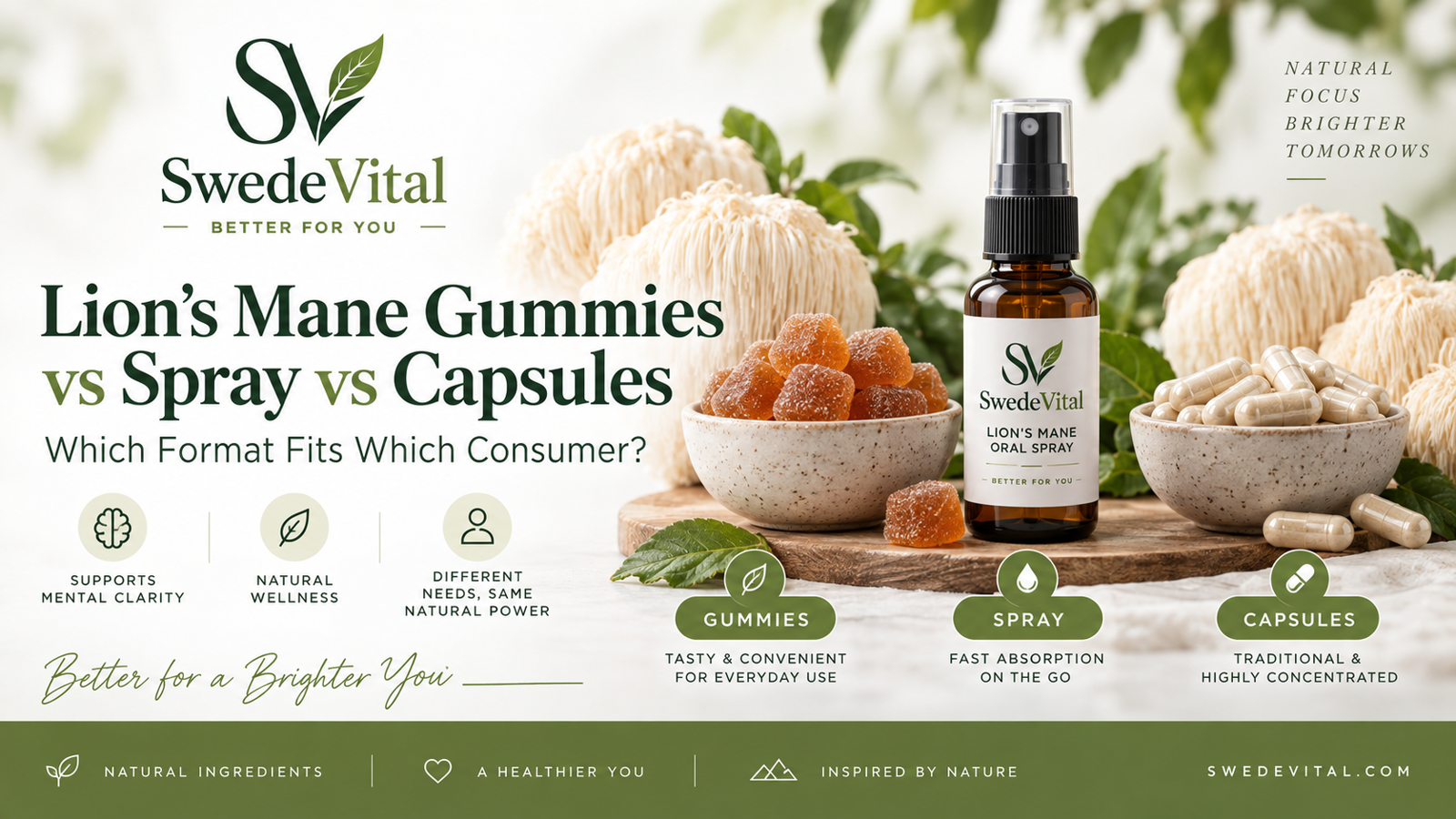
Lion's Mane Gummies vs Spray vs Capsules: Which Format Fits Which Consumer?
Kort sammanfattat
Lion's Mane gummies are best for taste and daily adherence, capsules excel in dose transparency for committed users, and dual-extract sprays offer fast, flexible dosing without swallowing.
TL;DR
- Gummies suit taste‑seeking beginners, capsules suit dose‑conscious users, and sprays bridge the gap with quick, adjustable dosing.
The short answer to Lion's Mane gummies vs capsules is that neither format is objectively better — they simply fit different consumers. Gummies win on taste and daily adherence for wellness-curious shoppers; capsules deliver higher, more transparent doses for committed users who read labels; and dual-extract sprays sit between the two, offering fast, flexible dosing with no water and nothing to swallow. For a retail buyer, the goal is not to pick a winner but to stock the format your specific customer will actually take every day.
This primer breaks down how each delivery format behaves, what to check on the label, and how to match Lion's Mane — and the wider functional-mushroom range — to the shopper in front of you.
Start with the consumer, not the mushroom
Functional mushrooms such as Lion's Mane (Hericium erinaceus) have been traditionally used in East Asian wellness practice and are now widely studied. But the active compounds only matter if the product gets taken consistently. That makes format a behavioural decision first and a biochemical one second.
Broadly, buyers can segment shoppers into three groups. The curious newcomer has seen mushroom gummies on social media and wants a low-commitment, pleasant way to try the category. The routine-builder already takes supplements and wants a clean daily dose without fuss. The optimiser reads extract ratios, tracks beta-glucan content, and stacks several products. Each group gravitates to a different format, and a well-merchandised shelf serves all three rather than betting on one.
Lion's Mane gummies vs capsules: the honest trade-off
The core of this decision comes down to palatability versus dose transparency.
The case for gummies
Mushroom gummies remove the two biggest barriers to trial: an earthy taste and the need to swallow a pill. They travel well, need no water, and feel more like a treat than a supplement, which is why they convert first-time buyers and support daily adherence. The trade-off is capacity. A gummy carries added ingredients — pectin or gelatine, sweeteners, flavouring — so the room left for concentrated mushroom extract is smaller than a capsule of the same size. Sugar content and the difference between a genuine fruiting-body extract and mere flavouring are where quality is won or lost.
The case for capsules
Capsules are the format of the label-reader. They can hold a denser, often standardised extract with few or no excipients, and they make the dose per serving easy to state clearly. That precision appeals to the optimiser who wants to know exactly how many milligrams of extract, and ideally what beta-glucan level, they are getting. The cost is experiential: capsules ask the user to swallow, offer no sensory reward, and can feel clinical to a newcomer. For a committed routine, none of that matters; for a curious first-timer, it can be the reason a jar stalls in the cupboard.
Rule of thumb: gummies sell the category and build the habit; capsules serve the consumer who has already bought into it and wants more control.
Where dual-extract sprays fit
Sprays are the format most buyers underrate. A dual-extract spray delivers an extract in liquid form under or into the mouth, absorbing quickly and letting the user fine-tune the number of pumps. That flexibility suits people who dislike swallowing pills but want something more concentrated and less sugar-led than a gummy — a bridge between the two ends of the spectrum.
The phrase “dual-extract” is worth explaining to shoppers because it signals process quality. Some of a mushroom's compounds (such as beta-glucans) are drawn out with hot water, while others (such as triterpenes in Reishi) are alcohol-soluble. A dual extraction uses both steps, so a dual-extract spray or tincture aims to capture a fuller spectrum than a single method alone. Sprays also shine for on-the-go dosing and for consumers who split their intake across the day.
The label details that decide quality
Format is only half the story. Across gummies, capsules and sprays, the same quality markers separate a serious product from a decorative one. Coach your category managers — and your shelf-edge copy — around these:
- Fruiting body vs mycelium. Extracts made from the fruiting body typically concentrate the compounds most studied, whereas mycelium grown on grain can carry starch from its substrate. Neither is inherently wrong, but the label should be honest about which it is.
- Extract vs raw powder. A concentrated extract (often shown as a ratio such as 10:1) is more potent per gram than plain milled mushroom powder. “Extract” on the front should be backed by detail on the back.
- Beta-glucan content. Beta-glucans are among the compounds researchers have studied most in functional mushrooms. A quantified beta-glucan figure — not just a total “polysaccharide” number, which can be inflated by starch — signals a maker who tests.
- Dose transparency. The extract weight per serving should be stated plainly, so shoppers can compare like with like rather than guessing.
- Third-party testing. Testing for heavy metals and contaminants matters because mushrooms concentrate what they grow in. Look for a documented testing process rather than an unsupported claim.
None of these markers promise an outcome. They simply help a buyer tell a credible product from a cosmetic one, whatever the format.
Lion's Mane gummies vs capsules: matching format to the shopper
Here is a practical decision framework for translating the Lion's Mane gummies vs capsules question into stocking and merchandising choices.
- New to the category, taste-sensitive, price-aware? Lead with gummies. They lower the barrier to first purchase and are the natural entry SKU for a mushroom gummies display.
- Consistent supplement user who wants a clean daily dose? Capsules. Fewer added ingredients, clearer dosing, easy to slot into an existing routine.
- Dislikes pills but wants concentration and control? A dual-extract spray. It threads the needle between gummy palatability and capsule potency.
- The optimiser who stacks several products? Offer capsules and sprays side by side, and make extract ratios and beta-glucan figures easy to compare on-shelf.
Because these formats serve different jobs, they are complements rather than competitors. Many stores see a customer enter through gummies and later trade up to capsules or sprays once the habit is set — which is an argument for carrying the range, not a single hero SKU.
Beyond Lion's Mane: the wider functional range
Lion's Mane is often the shopper's first mushroom, but the same format logic applies across a functional-wellness line, and cross-selling depends on knowing each one's traditional role:
- Reishi (Ganoderma lucidum) has traditionally been used to support a sense of calm and is studied for immune and sleep-related outcomes; its triterpenes make it a natural candidate for dual-extraction.
- Cordyceps has traditionally been associated with energy and stamina and has been studied in the context of exercise and endurance.
- Turkey Tail (Trametes versicolor) is rich in beta-glucans and has been studied for immune support.
- Creatine, though not a mushroom, is one of the most researched supplement ingredients for strength and exercise performance and increasingly for cognitive support — a strong companion SKU for the optimiser.
- Magnesium sleep gummies extend the gummy format into the evening routine; magnesium contributes to normal muscle and nervous-system function, and the format keeps the wind-down ritual simple.
A supplier such as SwedeVital carries these as capsules, dual-extract sprays and gummies precisely so a retailer can build one coherent shelf that speaks to newcomers and optimisers at once, with private-label options where a buyer wants to own the brand.
A buyer's format checklist
Before committing to a range, run each candidate product through this quick check:
- Does the assortment include at least one entry format (gummies) and one high-dose format (capsules or spray)?
- Is the extract source — fruiting body or mycelium — clearly stated?
- Is a real extract ratio or extract weight per serving on the label?
- Is beta-glucan content quantified rather than hidden inside a total polysaccharide figure?
- Is there documented third-party testing for contaminants?
- Are on-pack and shelf claims evidence-led (“traditionally used for”, “studied for”) rather than promising a cure?
- Do the formats let a shopper trade up over time without leaving your shelf?
Tick those boxes and the format question stops being a gamble and becomes a merchandising strategy: gummies to recruit, capsules and sprays to retain, all backed by a label a category manager can defend.
Frequently asked questions
Are Lion's Mane gummies as effective as capsules?
It depends on the dose and quality, not the format alone. A capsule can usually hold a higher, more concentrated extract, while a gummy trades some capacity for taste and easier daily use. Compare the stated extract weight and beta-glucan content per serving rather than assuming one format is stronger.
What is the difference between mushroom gummies and mushroom extracts?
Mushroom gummies are a delivery format; the extract is the active ingredient inside. A good gummy contains a genuine concentrated extract, ideally from the fruiting body. A poor one may use mostly flavouring with little real mushroom, so the label detail matters more than the word “mushroom” on the front.
Why choose a dual-extract spray over a gummy or capsule?
A dual-extract spray suits people who dislike swallowing pills but want more concentration and control than a gummy offers. It absorbs quickly, lets the user adjust the number of pumps, and — because dual extraction uses both water and alcohol steps — aims to capture a fuller spectrum of the mushroom's compounds.
Should Lion's Mane be from the fruiting body or mycelium?
Fruiting-body extracts typically concentrate the compounds most studied, while mycelium grown on grain can carry starch from its substrate. Both appear on the market; the key is that the label states clearly which is used and quantifies beta-glucans rather than a vague polysaccharide total.
Can I take Lion's Mane with other functional mushrooms?
Many people combine Lion's Mane with mushrooms such as Reishi, Cordyceps or Turkey Tail, and each has its own traditional role. As with any supplement, anyone who is pregnant, breastfeeding, on medication or managing a health condition should speak to a qualified professional first. These products are food supplements and are not intended to diagnose, treat or prevent any disease.
Which format should a retailer stock first?
If you can only start with one, gummies recruit the widest audience and introduce shoppers to the category. Add capsules and a spray as soon as possible so routine-builders and optimisers can trade up without leaving your shelf — the range works best as a ladder, not a single product.
Related reading
- Lion’s Mane gummies explained
- Lion’s Mane capsules guide
- Lion’s Mane spray guide
- Functional mushrooms overview
- Reishi format comparison
Sources
- Analysis of heavy metal characteristics and health risks of edible mushrooms in the mid-western region of China
- Lion's Mane Gummies vs Capsules: Which to Choose? · Europe | TuttiBear
- Mushroom Powder vs. Mushroom Extract: What's the ...
- Lion’s Mane Mushroom (Hericium erinaceus): A Neuroprotective Fungus with Antioxidant, Anti-Inflammatory, and Antimicrobi
- Organic Lion’s Mane Dual Extract (Freeze-Dried)
- Impact of high pressure pre-treatment and hot water extraction ...
Vanliga frågor
What makes Lion's Mane gummies more popular among beginners?
Gummies eliminate earthy taste and swallowing barriers, making them a treat‑like, easy‑to‑take option that encourages daily adherence.
Why are capsules preferred by dose‑conscious consumers?
Capsules hold denser, standardized extracts with clear milligram and beta‑glucan labeling, giving users precise control over their intake.
How does a dual‑extract spray differ from a single‑extract product?
A dual‑extract spray uses both hot‑water and alcohol extraction to capture a fuller spectrum of compounds, offering a more concentrated, flexible dosing experience.
What quality markers should I look for on any Lion's Mane product?
Check for fruiting‑body vs mycelium source, extract ratio, quantified beta‑glucan content, dose transparency, and third‑party testing for contaminants.
Which format is best for on‑the‑go dosing?
Dual‑extract sprays are ideal for on‑the‑go use, allowing quick absorption and adjustable dosing without water or swallowing.