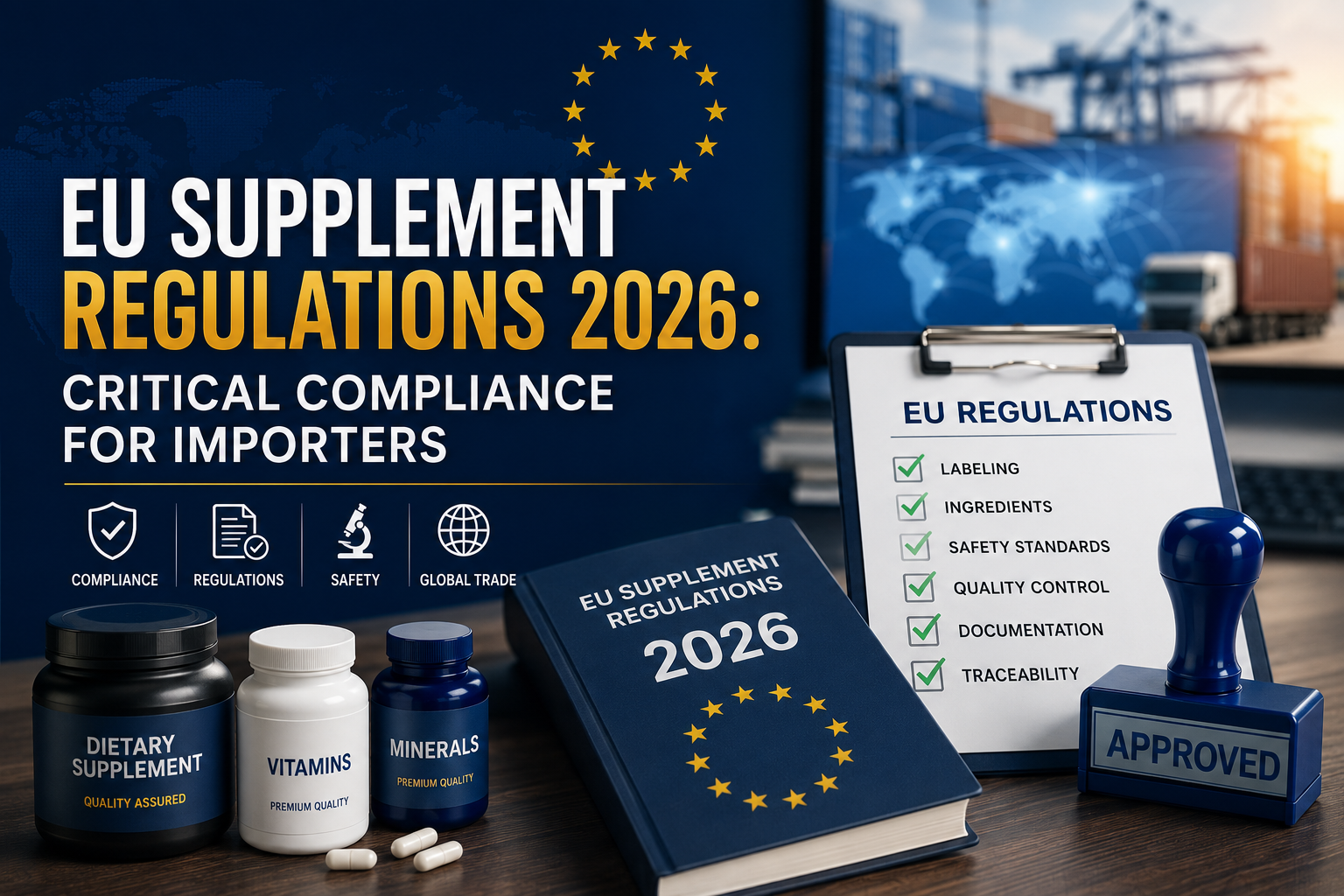
EU Supplement Regulations 2026: Critical Compliance for Importers
Kort sammanfattat
Under new EU supplement regulations for importers in 2026, companies must appoint a local Food Business Operator (FBO) within the EU-27. This entity assumes legal responsibility for product compliance, handling notifications and adverse event reporting. Without an FBO, shipments face border holds, making this structural adjustment critical for market access.
TL;DR
- Importers must appoint a local EU-27 Food Business Operator to handle regulatory liability and avoid customs delays under the 2026 regulations.
EU Supplement Regulations 2026: A Decision Framework for Importers
The European Union’s supplement market is projected to hit USD 38 billion by 2031, yet the regulatory maze that sits behind every bottle or packet can still trip up even seasoned importers. The key to staying compliant isn’t memorising a list of directives; it’s building a repeatable decision process that checks each product against the same set of criteria before it ever crosses an EU border.
Step 1: Verify the Product Category and Core Requirements
All supplements are treated as food under EU law, so they must satisfy the General Food Legislation. This includes:
- Safety and Hygiene: The manufacturer must prove that the product is safe for consumption.
- Traceability: Full ingredient lists, batch numbers, and production dates are mandatory.
- No Prohibited Substances: Certain vitamins or minerals above specified limits are banned.
If your item falls outside these basics—say it contains a novel functional ingredient—you’ll need to consult the EFSA Additive Assessment before proceeding.
Step 2: Align with Labeling and Packaging Directives (Regulation 1169/2011)
Label compliance is a non‑negotiable gatekeeper. The EU requires:
- Multilingual Text: All mandatory information must appear in the official language(s) of the destination Member State.
- Nutrient Declaration: Supplements must list energy, protein, fats, carbohydrates, and any declared vitamins/minerals per 100 g or per serving.
- Allergen Disclosure: Any allergenic ingredient (e.g., nuts, soy) must be highlighted in a separate “allergens” section.
- Country of Origin: The label must state the country where the product was manufactured.
Failure to meet any of these points can result in seizure or refusal at customs. A quick audit checklist—available from Global Import Agent—can save hours of re‑labeling work.
Step 3: Prepare the Health Certificate and Documentation for High‑Risk Foods
If your supplement contains ingredients that fall under “high‑risk” categories (e.g., certain animal derivatives or novel proteins), you’ll need a Health Certificate issued by an authorised body. This document confirms that:
- The product complies with hygiene standards.
- No prohibited substances are present.
- All traceability records are complete.
For example, a protein‑rich snack like SwedeVital Protein Bites must demonstrate that the whey or plant proteins meet EU safety thresholds before it can be imported.
Step 4: Navigate Customs and Border Controls (Council Directives 91/496/EEC & 97/78/EC)
The customs clearance process hinges on two key documents:
- Commercial Invoice – detailing value, quantity, HS code, and country of origin.
- Certificate of Origin – confirming the product was manufactured within an EU‑28 member state or a WTO‑approved partner.
Border inspection posts will verify that your supplement’s declared content matches the actual shipment. Any discrepancy can trigger delays, fines, or even confiscation.
Step 5: Post‑Entry Monitoring and Reporting
Member States reserve the right to request notification of a product’s market placement for monitoring purposes. Maintaining an up‑to‑date Product Registry—including batch numbers, expiry dates, and distribution channels—ensures you can respond swiftly if a recall or safety alert arises.
Practical Example: Importing SwedeVital Protein Bites into Germany
Scenario: A distributor in Berlin wants to stock the 150 g “Dates & Hazelnuts Coated with Coconut” variant.
- Category Check: It is a food supplement; safety and traceability verified by the manufacturer.
- Labeling: The label lists all required nutrients, allergens (hazelnuts), and country of origin (Sweden).
- Health Certificate: Issued by the Swedish Food Agency, confirming compliance with EU hygiene standards.
- Customs Docs: Commercial invoice uses HS code 2106.90, and a certificate of origin confirms Sweden as the manufacturing country.
- Post‑Entry
Vanliga frågor
Why is a local Food Business Operator (FBO) required for EU supplement imports in 2026?
Since Brexit, companies without an EU address can no longer register directly. An FBO within the EU-27 is mandatory to assume legal responsibility for product compliance, handle regulatory communications, and manage adverse event reporting.
What happens if an importer does not have an FBO in the EU?
Shipments may be held at borders due to non-compliance with registration requirements. This leads to significant financial losses, supply chain disruptions, and damaged relationships with retail partners who require verified compliance documentation.
Does the FBO requirement apply to non-EU exporters as well?
Yes, the rule applies equally to non-EU exporters. They must have a local representative within the EU-27 to act as the bridge between international suppliers and EU authorities for regulatory oversight.
How do these regulations impact the relationship between importers and retailers?
Retailers are increasingly selective, requiring partners who provide 'peace of mind' through robust documentation. Importers must demonstrate they are strategic advisors on compliance, not just logistics providers, to maintain trust and market access.
NyhetsbrevFler artiklar som denna — direkt i inkorgen