Private Label Health Manufacturing in Europe: The Strategic Guide
Kort sammanfattat
Europe is a strategic hub for private label health manufacturing due to its rigorous EU regulatory framework, GMP-certified facilities, and advanced production technology. Brands benefit from strict quality standards that build consumer trust, geographic proximity reducing lead times, and flexible low MOQs that allow for agile market testing and rapid scaling of products like collagen and adaptoge
TL;DR
- Europe offers a superior environment for private label health brands through high regulatory standards, trusted manufacturing infrastructure, and flexible production models.
Choosing the Right Private Label Health Manufacturer in Europe: A Decision Blueprint
When you’re ready to launch a health‑oriented brand, the first critical choice is who will turn your concept into a shelf‑ready product. In Europe, manufacturers differ not only in scale and cost but also in regulatory compliance, sustainability credentials, and flexibility for niche formulations. Below is a practical framework that lets you weigh these factors systematically.
1. Define Your Core Product Requirements
- Formulation Complexity: Are you producing simple capsules or multi‑ingredient powders? Complex blends often need dedicated mixing lines and stricter quality controls.
- Target Market Segments: Vegan, gluten‑free, or allergen‑free labels demand ingredient sourcing that meets those standards.
- Packaging Needs: Sustainable packaging (biodegradable sachets, recyclable glass) can be a differentiator but may increase lead time.
Document these requirements in a “Product Specification Sheet” before contacting manufacturers. It saves time and ensures you compare apples to apples.
2. Map the Regulatory Landscape
- EU GMP & EU Novel Food: Manufacturers must hold Good Manufacturing Practice certificates for supplements or food products, depending on your category.
- Labeling Compliance: Nutrient claims and health statements must align with EU Regulation (EC) No 1924/2006.
- Country‑Specific Rules: For instance, Spain’s “Bios” certification is mandatory for organic supplements sold there.
Ask each potential partner to provide a copy of their GMP certificate and any relevant third‑party audit reports. Verify that they can support your intended distribution countries without additional regulatory hurdles.
3. Evaluate Production Capacity & Flexibility
- Batch Size Options: Can the manufacturer handle both small pilot runs (≤ 5 kg) and large commercial batches (> 10 t)?
- Changeover Time: Short changeover times mean you can launch new flavors or formulations quickly.
- Technology Stack: Look for facilities equipped with automated weighing, mixing, and filling lines if you plan rapid scaling.
A manufacturer that offers a “scale‑up” pathway—starting with small batches and ramping to full production—reduces upfront risk.
4. Assess Quality Assurance & Traceability Systems
- Batch Records: Must be digitally captured, searchable, and auditable.
- Third‑Party Testing: Independent labs should verify potency, purity, and contaminant levels.
- Recall Protocols: Clear procedures for product withdrawal demonstrate preparedness for safety incidents.
Request a recent audit report or ISO 22000 certification to confirm robust QA practices.
5. Sustainability & Ethical Credentials
- Ingredient Sourcing: Does the manufacturer use certified organic, fair‑trade, or locally sourced ingredients?
- Carbon Footprint: Look for facilities that report energy usage and have renewable energy targets.
- Packaging Sustainability: Availability of recyclable or compostable packaging options can be a selling point in eco‑conscious markets.
These factors not only meet consumer expectations but also future‑proof your brand against tightening regulations.
6. Cost Structure Analysis
- Unit Price vs Volume: Negotiate tiered pricing that rewards higher volumes.
- Hidden Fees: Be wary of setup charges, changeover fees, or packaging design costs.
- Total Cost of Ownership: Include logistics, customs duties, and potential re‑labeling expenses if you plan to sell in multiple EU states.
Create a spreadsheet that compares at least three manufacturers on these cost elements. The lowest unit price isn’t always the best deal if it comes with higher hidden costs.
7. Pilot Production & Sensory Evaluation
- Sample Batch: Request a pilot run that matches your final formulation.
- Sensory Testing: Conduct blind taste tests to confirm flavor, texture, and aroma meet brand standards.
- Packaging Fit‑Test: Verify that the chosen packaging holds up under shipping conditions.
A successful pilot run is a strong indicator of future production reliability.
8. Decision Matrix & Final Selection
Create a weighted scoring sheet where each criterion (regulatory compliance, capacity, QA, sustainability, cost) receives a weight based on your strategic priorities. Score each manufacturer and calculate the total score to identify the best fit objectively.
“Choosing a private label partner is less about finding the cheapest option and more about aligning capabilities with brand vision.”
Case in Point: SwedeVital’s Private Label Journey
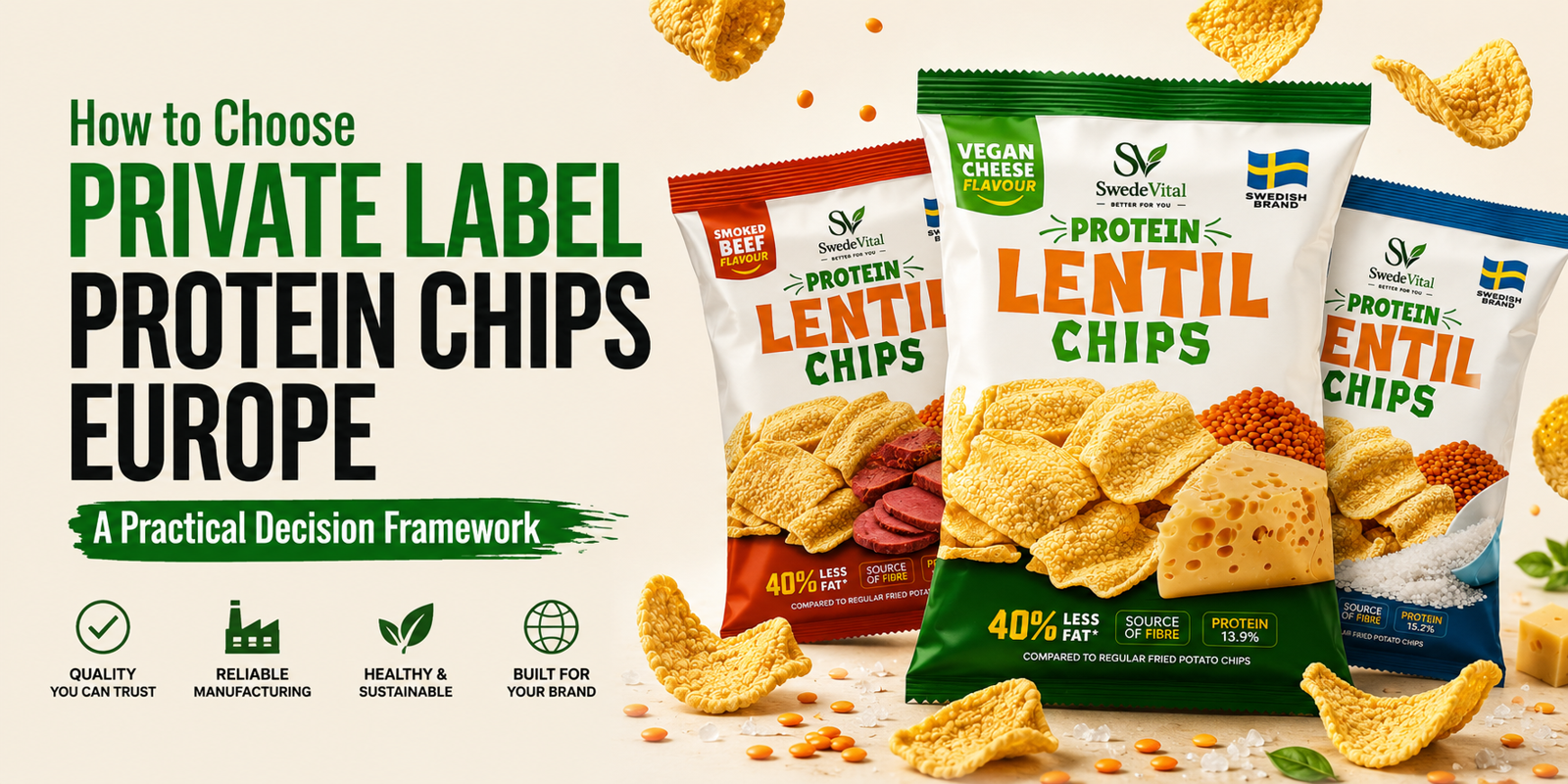
SwedeVital leveraged this framework to partner with a GMP‑certified European manufacturer that offered scalable production for its protein snack line. By prioritizing
Vanliga frågor
Why is Europe a strategic hub for private label health manufacturing?
Europe combines strict regulatory rigor with advanced production technology and consumer trust. Its adherence to GMP standards ensures high safety, while geographic proximity to distribution centers reduces lead times and carbon footprints.
What are the key regulatory requirements for private label supplements in Europe?
Manufacturers must adhere to comprehensive EU regulations, including GMP, ISO, and HACCP certifications. Ingredients must follow specific nomenclature, and health claims require approval from the European Food Safety Authority (EFSA).
What are the fastest-growing private label health product categories in Europe?
Key growth areas include collagen-based products for beauty-from-within, adaptogenic supplements like Ashwagandha KSM-66 for stress relief, and essential micronutrients such as Magnesium Glycinate and Vitamin D3.
How do low MOQs benefit private label health brands in Europe?
Low Minimum Order Quantities allow startups and small businesses to validate market fit with minimal risk. This agility enables retailers to test demand before committing to large-scale production, facilitating faster response to consumer trends.